
Our Concrete Slabs Services in Atlanta
Six situations where a properly built slab is the right answer.
-
Shed and Outbuilding Bases
A level, square, well-drained base is what keeps a timber shed off wet ground and stops the floor rotting. Sized slightly beyond the building footprint so water drips clear rather than tracking back underneath.
-
Garage and Workshop Floors
Thicker, reinforced slabs built to take vehicle weight, jacks and equipment without cracking. Poured with a fall toward the door so washdown water and rain off the car actually leaves the building.
-
Home Addition Slabs
Slab-on-grade for extensions and sunrooms, with thickened edges, insulation and a vapour barrier where the space is heated. These need to tie into the existing structure correctly and pass inspection.
-
Equipment and HVAC Pads
Small but critical pads for air conditioning units, generators and pool equipment. They must stay dead level and not settle, since a tilting pad puts strain on the connections and mountings above it.
-
Footings and Foundations
Strip footings and pads under walls, columns and porches, excavated to stable bearing and poured to engineered specification. Sized for the load above and the clay below, then drained around properly.
-
Patio and Under-Deck Slabs
Ground-bearing slabs forming a patio or a clean, dry surface beneath a raised deck. Graded to shed water away from the house rather than trapping it against the foundation where it does damage.
Our Concrete Slab & Foundation Work in Atlanta
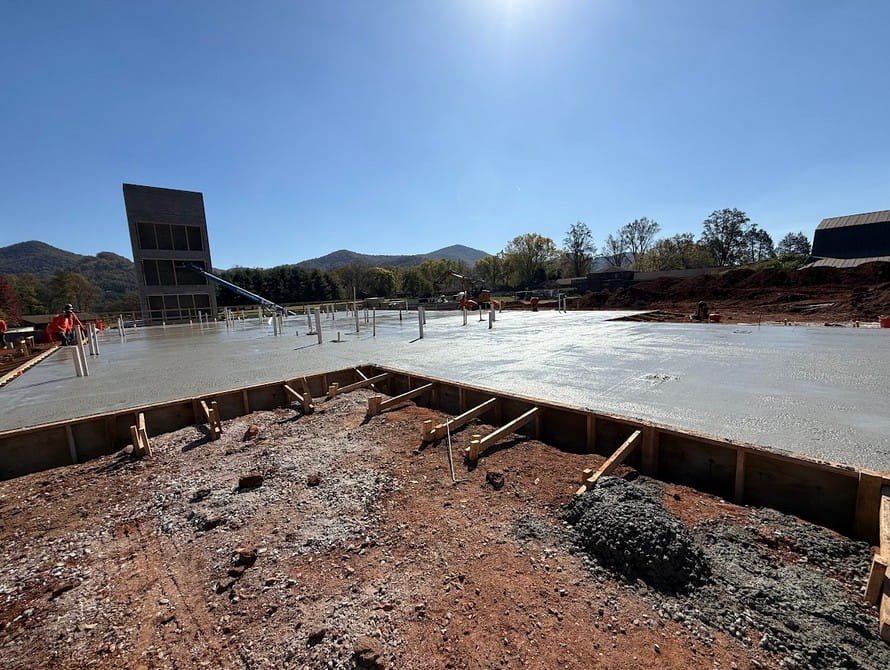
Why Choose Our Concrete Slabs & Foundations Company in Atlanta
-
Subgrade Prepared and Verified
We excavate to firm ground, then build back up in compacted lifts. It is invisible once poured and it is the single factor that decides whether a slab is still flat in fifteen years.
-
Reinforcement to Suit the Use
Mesh for a shed base, rebar on chairs for a garage floor, engineered detailing for a footing. We specify to the actual loading rather than putting the same mesh in every pour regardless.
-
Joints Cut on Time
Concrete will crack; control joints decide where. We cut at the right spacing and, critically, within the right window after the pour, so cracking follows our lines instead of wandering.
-
Drainage Sorted First
A slab that dams water against your house creates a foundation problem. We set falls and, where needed, install drainage so surface and groundwater are routed away before the pour goes down.
-
Poured for the Weather
Atlanta heat flashes off a slab surface and cold snaps stall the set. We time pours, adjust the mix and cure properly, because concrete finished in the wrong conditions never reaches design strength.
-
Inspection-Ready Documentation
For structural work we keep mix tickets, pour records and inspection sign-offs and hand them over. It matters at inspection, at resale, and any time somebody asks what is actually under there.
Cost of Concrete Slabs & Foundations in Atlanta
Concrete slabs in Atlanta typically cost $6 to $14 per square foot, with most residential slabs landing between $2,500 and $9,000. A four-inch patio or shed base sits at the affordable end; a six-inch reinforced garage or workshop slab with a thickened perimeter runs toward the top. A standard two-car garage slab commonly falls between $4,000 and $9,000.
Thickness is only half the answer — the compacted base beneath matters just as much, and a poorly prepared base will crack a six-inch slab as readily as a four-inch one. Under any slab inside a conditioned building Georgia code requires a vapour barrier, and skipping it is what destroys flooring adhesives from below in a humid climate like ours.
Atlanta Concrete Slabs & Foundations Cost Breakdown
| Project Type | Typical Cost Range | Notes |
|---|---|---|
| 4" slab (patio, walkway, shed base) | $6–$10 per sq ft | Wire mesh on chairs; pedestrian use |
| 5–6" reinforced slab | $9–$14 per sq ft | Rebar grid; vehicles and building loads |
| Monolithic slab with thickened edge | $10–$18 per sq ft | Slab and footing poured together |
| Two-car garage slab | $4,000–$9,000 | Typical residential size, reinforced |
| Excavation and compacted base | $2–$5 per sq ft | Depth depends on ground conditions |
| Vapour barrier | $0.50–$1.50 per sq ft | Code requirement under conditioned space |
| Removing an existing slab | $3–$8 per sq ft | Demolition and haulage priced by volume |
| Permit and inspection | $150–$800 | Required where the slab carries building load |
Please note this is only an estimate. You can get a more accurate quote when you call our team or provide specific project details in our contact form.
Concrete Slabs & Foundations FAQs
How thick should a concrete slab be?
Four inches suits patios, walkways and shed bases. Driveways and anything taking vehicles want five to six inches with heavier reinforcement. Garages, workshops and slabs carrying building load need engineered thickness and a thickened perimeter. Thickness is only half the answer, though: the compacted base beneath it matters just as much.
How much does a concrete slab cost in Atlanta?
Slabs are priced by square footage, with thickness, reinforcement, excavation, base depth and access adjusting the rate. Removing an existing slab adds a real cost, since demolition and haulage are charged by volume. We measure, confirm the specification required for the use, and quote each element separately.
Does a concrete slab need a vapour barrier in Georgia?
Under any slab inside a conditioned building, yes, and it is code. Georgia humidity drives moisture up through concrete, which then destroys flooring adhesives and finishes from below. We lay polythene over the compacted base with lapped and taped joints. Exterior patio slabs do not need one.
How long does a concrete slab take to cure?
Foot traffic is fine after a day or two, vehicles after about a week, and full design strength arrives near twenty-eight days. Flooring should not go down until moisture testing passes, which takes longer in humid conditions. We keep slabs damp-cured through the first days, because that is where strength is won.
Do concrete slabs need rebar, or is wire mesh enough?
Mesh is adequate for a simple four-inch patio, controlling shrinkage cracking once it is properly supported on chairs rather than trodden into the base. Anything carrying vehicles or building load needs rebar on a designed grid. Over Georgia clay we lean toward rebar, because that ground moves seasonally.